
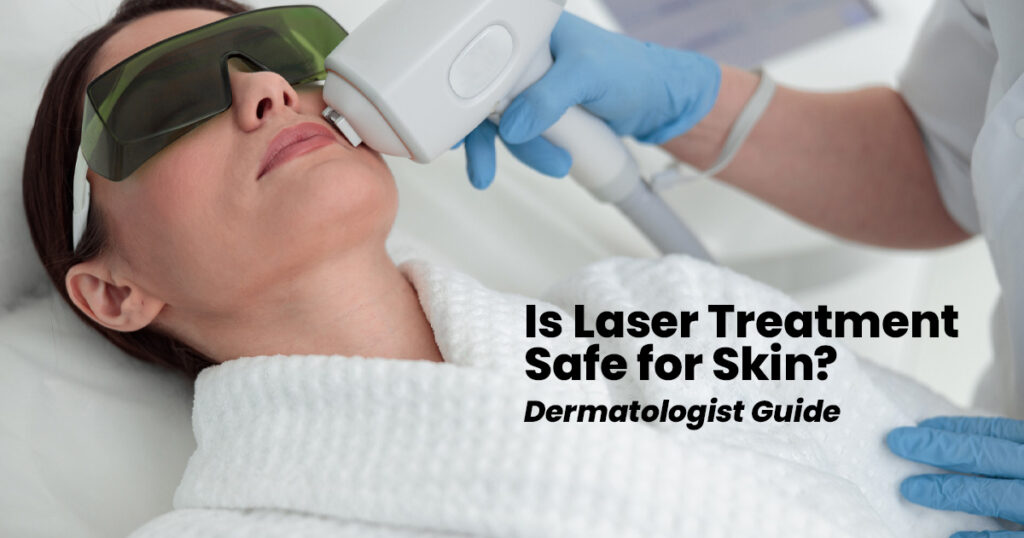
Laser treatments are something I discuss with patients almost every day. Some are excited about it, some are nervous, and many are unsure whether it is actually safe for their skin. So let’s clear this first; Is Laser Treatment Safe for Your Skin?
Laser treatment is generally safe, but only when it is done with proper medical care, in the right settings, and by someone who actually understands skin, not just the machine.
I have seen both sides in my practice: patients who get excellent results, and others who come in after complications from poorly done treatments elsewhere. The difference is almost always who performed it, not the laser itself.
Table of Contents
- What laser treatment really does to the skin
- How the skin actually responds to laser energy
- Different types of laser treatments (and why they matter)
- So, is laser treatment actually safe?
- When laser treatment is considered safe
- What happens when laser treatment is not done properly
- Why the laser machine itself matters
- Who usually benefits from laser treatment
- What results can you realistically expect?
- Why choosing the right dermatologist changes everything
- What the treatment actually feels like
- Aftercare is just as important as the treatment
- When you will actually see results
- Final thoughts
What laser treatment really does to the skin
In simple terms, laser treatment uses focused light to target specific skin concerns. It does not randomly “damage” the skin. Instead, it works in a controlled manner on very specific layers. Depending on the settings, the laser may remove damaged surface skin or reach deeper layers to trigger healing from within. The important thing to understand is that your skin is not being forced into change it is being gently guided to repair itself.
How the skin actually responds to laser energy
When laser light enters the skin, it is absorbed by pigment, water, or tiny blood vessels, depending on the treatment type. This creates controlled heat in a very targeted area. The surrounding skin is usually left untouched when the procedure is done correctly. After this controlled response, your body begins naturally repairing the area. New collagen forms, damaged pigment breaks down, and over time, the skin starts to look smoother and more even.
This healing process is gradual. It doesn’t happen overnight, and that is actually a good sign – because real skin improvement takes time.
Different types of laser treatments (and why they matter)
Not all laser treatments are the same, and this is where many patients get confused.
Fractional lasers are commonly used for acne scars and uneven texture. They work in tiny micro-zones, which allows faster healing and less downtime.
CO2 lasers are more powerful and used for deeper issues such as scars, wrinkles, and sun damage. They give more visible results but require careful handling and recovery time.
Q-switched lasers are often used to treat pigmentation problems such as melasma or dark spots. They break pigment into smaller particles so the body can clear it naturally.
Choosing the wrong type of laser for your skin is one of the main reasons people later experience problems.
So, is laser treatment actually safe?
Yes – but only under the right conditions.
Laser treatment has been used safely in dermatology for many years. In a clinical environment, it has a very good safety profile.
However, the word “safe” depends on three things: your skin, the machine, and the person operating it.
If even one of these is wrong, problems can occur.
When laser treatment is considered safe
From a medical point of view, laser treatment is safe when:
- The skin is properly examined before starting.
- The correct laser type is selected.
- Energy levels are adjusted to your skin type.
- The procedure is done in a controlled medical setting.
Under these conditions, most patients experience only mild redness or slight sensitivity, which settles quickly.
What happens when laser treatment is not done properly
This is where I want patients to be careful.
When laser treatment is done without proper training or in non-medical environments, the risks increase significantly.
I have seen cases where patients developed:
- Dark patches that were not there before
- Burns that took weeks to heal
- Scarring from overly aggressive settings
- Uneven skin tone that became harder to treat later
These are not caused solely by the laser – they occur due to incorrect usage. Unfortunately, these complications are often preventable.
Why the laser machine itself matters
Another important factor is the machine being used. Medical-grade lasers are designed with safety controls, cooling systems, and precise calibration. These features help protect the skin during treatment.
On the other hand, lower-quality devices or non-medical machines often lack the same level of control, thereby increasing the risk.
So even if the technique is correct, the equipment still matters.
Who usually benefits from laser treatment
Laser treatment can be helpful for many common skin concerns. Patients with acne scars, uneven skin tone, pigmentation, sun damage, or early signs of aging often respond well. But it is not a one-size-fits-all treatment. Every skin behaves differently, and that is why consultation is important before starting. There are also situations in which we delay treatment, for example, active skin infections or certain sensitive skin conditions.
What results can you realistically expect?
One thing I always explain to patients is that laser treatment is not instant. You may notice slight improvement early on, but real changes happen gradually as collagen builds and the skin repairs itself. Most people start seeing noticeable improvement within a few weeks and continue progress over the next couple of months. The goal is not just quick results but stable, healthy skin improvement.
Why choosing the right dermatologist changes everything
This is probably the most important part of the entire process. Laser treatment is not just about technology. It is about judgment – knowing how your skin will respond, how much energy to use, and when to stop. An experienced dermatologist adjusts everything in real time based on the skin’s response. That level of control is what keeps the treatment safe. That is also why patients prefer care from experienced professionals, where every treatment is carefully planned rather than rushed.
What the treatment actually feels like
Most patients are surprised that laser treatment is not as uncomfortable as they expect. You may feel a warm or slight pricking sensation during the session. In some cases, numbing cream is used to make it more comfortable. The session itself is usually quick, depending on the area being treated.
Afterward, the skin may feel slightly warm or sensitive, but this settles soon.
Aftercare is just as important as the treatment
What you do after laser treatment has a big impact on your results. The skin becomes more sensitive for a short time, so gentle care is important. I usually advise patients to avoid direct sun exposure, use mild skincare products, and apply sunscreen regularly. Most side effects, like redness or mild swelling, are temporary and part of the normal healing process.
When you will actually see results
Laser results take time. That is something patients should always understand before starting. Some improvements may appear early, but bigger changes, like collagen remodeling, can take weeks to months. Skin continues to improve gradually even after the sessions are complete.
Final thoughts
Laser treatment can be very safe and effective, but only when done with proper medical guidance. The biggest mistake people make is choosing based on price or convenience instead of expertise. If you are considering laser treatment in Islamabad, the safest first step is always a proper consultation with a qualified dermatologist who understands both your skin and the technology being used.
That decision alone often determines your results more than anything else.
- Book This Treatment
Enquire About Dermal Fillers & Botox
Tell us a little about your concern — our team will call you back to confirm your appointment.