
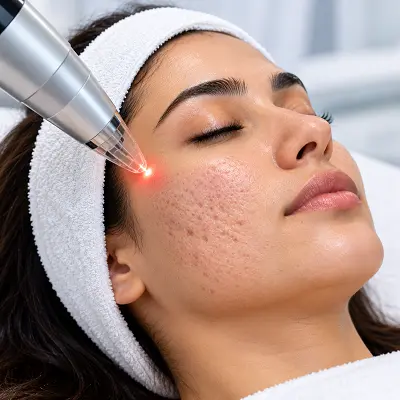
The fastest way to reduce acne scars is to match the clinical treatment to your scar type. Red and brown acne marks fade in 4 to 8 weeks with PICO laser, vascular laser, or medical-grade chemical peels. Pitted (atrophic) scars need collagen-remodelling procedures such as subcision, RF microneedling, fractional CO2 laser, or TCA CROSS. Most patients see a visible change after the first session and the main improvement within 3 to 6 months. No treatment erases deep scars overnight; a combined, doctor-led plan is what shortens the timeline.
At Dermalase, Dr. Shumaila Khan and her team of skin doctors start every acne scar plan with one question: what kind of scar is this? The answer decides how fast your skin can improve.
Table of Contents
- Acne Marks vs Acne Scars: Know What You Are Treating
- How Fast Can Acne Scars Fade? A Realistic Timeline
- Treatments That Reduce Acne Scars Fastest, Matched to Scar Type
- Acne Scar Treatment for Pakistani Skin Tones
- Acne Scar Severity Grading: How Your Treatment Plan Is Decided
- Who Is a Good Candidate for Acne Scar Treatment?
- Before and After Your Acne Scar Treatment Sessions
- Acne Scar Treatment at Dermalase, F-10 Islamabad
- When Should You See a Skin Specialist?
- Book Your Acne Scar Consultation with Dr. Shumaila Khan
- Frequently Asked Questions
Acne Marks vs Acne Scars: Know What You Are Treating
Many people in Islamabad and Rawalpindi call every spot left after a pimple a “scar.” Medically, these are two different problems, and they heal at very different speeds.
| Type | What it looks like | Skin texture | How fast it improves |
| Post-inflammatory hyperpigmentation (PIH) | Brown or dark spot | Flat | Fastest: 4 to 12 weeks with treatment |
| Post-inflammatory erythema (PIE) | Red or pink spot | Flat | 6 to 12 weeks with treatment |
| Atrophic scar (ice pick, boxcar, rolling) | Pit, dent or wave in the skin | Depressed | Gradual: 3 to 6 months of sessions |
| Hypertrophic scar or keloid | Raised, firm bump | Raised | Flattens over 2 to 4 months of injections |
A quick self-check: stand under side lighting from a window. If the spot casts a shadow, it is a textural scar. If it is only a colour change on smooth skin, it is a mark, and it will respond much faster.
How Fast Can Acne Scars Fade? A Realistic Timeline
Collagen, the protein that fills in pitted scars, takes time to rebuild. This is what a typical treatment journey looks like:
| Time | What happens |
| Week 1 | Skin assessment, scar mapping, active acne controlled first |
| Weeks 2 to 4 | First procedure; redness settles in 1 to 7 days depending on treatment |
| Weeks 4 to 8 | Brown and red marks visibly lighter; first texture change noticed |
| Months 2 to 4 | Second and third sessions; rolling and boxcar scars look shallower |
| Months 4 to 6 | Collagen keeps remodelling; most patients see their main result |
| After 6 months | Results are long-lasting as long as new acne is kept under control |
Speed depends on four things: scar type, scar depth, your skin tone, and whether active acne is still forming new scars.
Treatments That Reduce Acne Scars Fastest, Matched to Scar Type
Ice Pick Scars: TCA CROSS
Ice pick scars are narrow and deep, like a needle prick. Lasers alone barely reach their base. In TCA CROSS, a high-strength trichloroacetic acid is placed precisely inside each scar with a fine applicator. This triggers new collagen from the bottom up. Most patients need 3 to 5 sessions spaced 4 to 6 weeks apart, with only small crusts for a few days.
Rolling Scars: Subcision
Rolling scars give the skin a wavy, uneven look. They happen because fibrous bands pull the skin down from underneath. Subcision uses a special needle under local anaesthesia to release those bands, so the skin lifts back up. It often gives the most noticeable improvement after a single session. Bruising lasts 7 to 14 days. For deeper dents, a small amount of hyaluronic acid filler can lift the area immediately.
Boxcar Scars: RF Microneedling and Fractional CO2 Laser
Boxcar scars are wide with sharp edges. Two options work best:
- RF microneedling (Scarlet, Sylfirm X): fine needles deliver radiofrequency energy deep into the dermis to tighten and rebuild collagen. It is safer for brown skin and has 1 to 3 days of redness. Usually 3 to 4 sessions, 4 to 6 weeks apart. Read more on microneedling for acne scars.
- Fractional CO2 laser: resurfaces the top layers and stimulates strong collagen growth. Results per session are larger, but downtime is 5 to 7 days and it needs careful settings on darker skin.
Raised (Hypertrophic) Scars and Keloids: Steroid Injections
Raised scars have too much collagen, so collagen-building treatments make them worse. They are flattened with intralesional steroid (triamcinolone) injections every 4 to 6 weeks, often combined with silicone gel. Some cases also benefit from vascular laser.
Brown and Red Acne Marks: PICO Laser, Peels and Topicals
Flat marks respond quickest. PICO laser breaks up pigment with almost no downtime. Chemical peels such as salicylic, glycolic or mandelic acid speed up skin renewal. A vascular-targeting laser (such as Nd:YAG) reduces stubborn red marks. See our full guide to hyperpigmentation treatment.
Why Combination Treatment Gives Faster Results
Most faces have two or three scar types at the same time. Treating only one type leaves the others behind. A combined plan, for example, subcision for rolling scars, TCA CROSS for ice picks and RF microneedling for overall texture, often in the same visit, shortens the total treatment time. Adding PRP (platelet-rich plasma) can support healing and reduce downtime.
| Scar type | Best treatment | Typical sessions | Downtime |
| Ice pick | TCA CROSS | 3 to 5 | 3 to 5 days of small crusts |
| Rolling | Subcision (± filler) | 1 to 3 | 7 to 14 days of bruising |
| Boxcar | RF microneedling or fractional CO2 | 3 to 4 | 1 to 7 days |
| Hypertrophic / keloid | Steroid injections + silicone | 3 to 6 | None |
| Brown / red marks | PICO laser, peels, topicals | 3 to 6 | None to 2 days |
Acne Scar Treatment for Pakistani Skin Tones
Most skin in Pakistan falls between Fitzpatrick types III and V. This skin heals well but forms dark spots (PIH) more easily after heat or injury. Aggressive treatment done without care can leave you with new pigmentation on top of your scars.
That is why Dr. Shumaila Khan’s team:
- Prepares the skin 2 to 4 weeks before procedures with pigment-calming creams such as azelaic acid
- Chooses lower-heat options like RF microneedling and PICO laser for darker skin
- Adjusts laser depth and density for each skin type instead of using one setting for everyone
- Insists on daily SPF 50 sunscreen, especially in Islamabad’s strong summer sun
Acne Scar Severity Grading: How Your Treatment Plan Is Decided
Dr. Shumaila Khan’s team grades acne scars on the Goodman and Baron qualitative scale, which skin specialists use worldwide. Your grade decides which treatments are combined and how many sessions you need.
| Grade | What it means | Usual treatment approach |
| Grade 1 – Macular | Flat red or brown marks, no texture change | PICO laser, vascular laser, chemical peels |
| Grade 2 – Mild | Shallow scars seen up close, hidden by makeup | RF microneedling, medium-depth peels |
| Grade 3 – Moderate | Scars seen at normal talking distance, not hidden by makeup | RF microneedling with subcision, or fractional CO2 laser |
| Grade 4 – Severe | Deep scars seen from a distance | Subcision + TCA CROSS + fractional CO2 or RF microneedling, with filler where needed |
Who Is a Good Candidate for Acne Scar Treatment?
You are a good candidate if your active acne is under control, the skin over the scars is healthy with no infection, and you want a gradual, natural improvement rather than an overnight change.
Your doctor may delay or change the plan if you:
- Still have active or cystic acne
- Are taking isotretinoin or stopped it recently (your doctor decides the safe timing)
- Are pregnant or breastfeeding (some peels and lasers are avoided)
- Have a history of keloids (needling depth and laser settings are adjusted)
- Get frequent cold sores (antiviral cover is given before laser resurfacing)
Before and After Your Acne Scar Treatment Sessions
Before treatment:
- Use the pigment-calming cream your doctor prescribes for 2 to 4 weeks if you have brown skin
- Stop retinoid creams 3 to 5 days before the session
- Avoid waxing, threading or bleaching on the area for one week
After treatment:
- Apply the prescribed healing cream and medical-grade SPF 50 sunscreen
- Avoid direct sun, gym, sauna, and swimming for 48 hours
- Skip makeup for 24 to 48 hours after needling or laser
- Do not pick crusts or peeling skin
- Return for your review visit after 4 to 6 weeks
Acne Scar Treatment at Dermalase, F-10 Islamabad
Dr. Shumaila Khan holds a Diploma in Dermatology from Cardiff, Wales (UK) and is board certified by the American Academy of Aesthetic Medicine (AAAM). With over 16 years of practice, she leads a team of skin doctors at Dermalase, A-103, Main Sumbal Road, F-10/1, Islamabad, serving patients from Islamabad, Rawalpindi, and overseas.
How your acne scar plan works:
- Skin analysis: your scars are mapped by type, depth, and skin tone.
- Personal plan: Dr. Shumaila Khan combines the right treatments for each scar type.
- Treatment sessions: done with FDA-approved technology, including RF microneedling, PICO laser and fractional CO2 laser.
- Follow-up: progress photos at each visit so you can see the change.
Cost: acne scar treatment cost in Islamabad depends on scar type, treated area, and number of sessions. You get an exact quote after your skin assessment, with no hidden charges. Learn more on our acne scar treatment in Islamabad page.
When Should You See a Skin Specialist?
Book a consultation if your marks have not faded after 3 months, if you can see dents or pits in side lighting, if your scars are raised or itchy, or if you are still getting new breakouts. The earlier scars are treated, the faster and better they respond.
Book Your Acne Scar Consultation with Dr. Shumaila Khan
Your scars did not form in a day, but the right plan can change them faster than you think. Get your scars assessed by Dr. Shumaila Khan and her team at Dermalase, F-10 Islamabad, and leave with a clear treatment plan and timeline.
Call or WhatsApp a photo of your skin on (+92) 303 555 8444 for quick guidance.
Visit: A-103, Main Sumbal Road, F-10/1, Islamabad · Mon–Sat
Frequently Asked Questions
What is the fastest treatment for acne scars?
For rolling scars, subcision gives the quickest visible change, often after one session. For overall texture, fractional CO2 laser gives the biggest change per session. For dark marks, PICO laser and chemical peels work fastest.
How many sessions will I need?
Most patients need 3 to 6 sessions spaced 4 to 6 weeks apart. Mild marks may need fewer; deep mixed scars may need more.
Can I treat acne scars while I still have active acne?
Active acne should be controlled first. Some treatments, such as peels and certain lasers, can treat acne and marks together, but procedures like subcision and CO2 laser are best done once breakouts settle.
Is acne scar treatment painful?
A numbing cream is applied before most procedures. Patients usually feel mild warmth or pricking. Subcision is done under local anaesthesia.
Is laser safe for brown Pakistani skin?
Yes, when the right device and settings are chosen by a trained doctor. RF microneedling and PICO laser carry a lower risk of dark spots in brown skin.
How soon can I go back to work?
After peels, PICO laser and RF microneedling, most people return the same or next day. After fractional CO2 laser or subcision, plan for about a week.
Which treatment is best for deep pitted acne scars?
Deep pitted scars respond best to a combination: subcision to release tethered scars, TCA CROSS for ice pick scars, and fractional CO2 laser or RF microneedling to rebuild collagen across the whole area.
What is the cost of acne scar treatment in Islamabad?
Cost depends on your scar grade, the treated area and the number of sessions. At Dermalase you receive an exact quote after your skin assessment with Dr. Shumaila Khan's team.